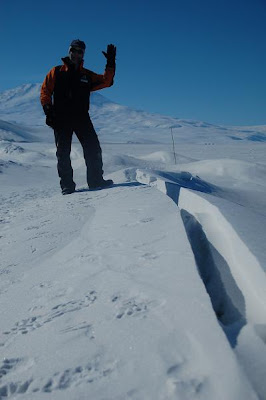
[The Barnes Glacier Crack]
[Driving on the sea ice]

[Barnes Glacier]

 [Weddell Seal]
 [Drilling a sea ice profile]
Finally we arrived at Royds. We stumbled out of the Hagglund, grabbed our bags and headed for the peninsula. We started by hiking up a slope to find two frozen water lakes. Their surfaces frozen to a smooth glassy sheen that rippled like liquid water. Parts of the surface were pocketed with holes made by dust and stone blown onto the surface and causing differential melting. It was great fun to carefully slide across the surface. At one point I bent down to lick the ice to see if it was fresh or salty, I discovered much to my companions delight that it was quite salty and didn’t taste all that great.

[Frozen lake at Cape Royds]

[The Ross Sea]
We wandered along the coast and took pictures of penguins and seals. We found a really neat pressure dome to climb inside and explore. And we eventually made our way over to Shackleton’s hut nestled beside the penguin rookery and out of the prevailing wind by the surrounding volcanic hills. The raucous sounds of the penguins filled the air almost as much as their fishy smell. To think that these are the same smells and sounds and sights that Shackleton and his men shared is a neat feeling. It was a neat feeling. The inside of the hut was pretty amazing as well. The musty light filtering through the old glass windows playing with the dust moats in the air. It was very still and quiet there, filled with the tedious memories of cooking dinner on a wood stove, eating dehydrated eggs from a can and fiddling in the dark room with cold fingers to produce the images we can see today in books and museums. Very cool indeed.
 [Penguin prints]
[Adelie penguins]
 [Adelie penguin]
 [A pressure dome in the sea ice]
 [Walking along the sea ice]


Soon our times was running short and we still had a 3 hour trip home. So we climbed back into the Hagglund and rumbled across the sea ice to our own little oasis on the other side of Ross Island.