Showing posts with label ice. Show all posts

Tuesday, November 23, 2010

Pressure Ridges


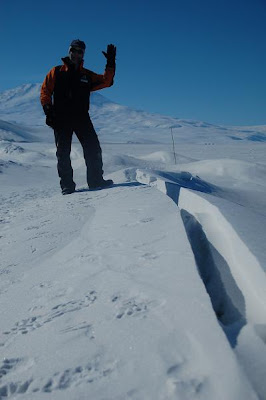
Just off shore in front of Scott Base is a sinuous line of tumbled ice blocks the size of cars and houses. The line follows the curve of the shore, running parallel to it as it goes. These are pressure ridges – where the dynamic, or moving, ice of the sea runs up against the static, or unmoving, ice glued to the shore. As the two solid surfaces of ice are pushed together by wave and tidal action they become plastic and deform into the dramatic shapes seen out our windows here.


There is a flagged route that leads you through the maze of sculpted figures, taking you past one that looks like a horse rearing up, around another the size of a house, and between two that resemble waves about the crash together over top of you. On the other side of the major thrust you can see new ones just beginning to form. Low rolls in the ice that appear to grow in size as they approach the line of crashing ice. The small ones look almost like seals buried in the snow, while the big ones could be the backs of whales as they come up to breach. In the really big ones you also start to see cracks running along the length of their spines, splitting them in two and allowing them to be thrown up against each other to make new shapes for the wind to sculpt.


Commonly found on the other side of the pressure ridges are seals. Because of the ongoing action with the ice, there are often cracks and holes open to the sea below. This allows the seals to come up. On our walk we came across one mum and her pup resting by a hole. The Weddell Seal is the most commonly seen seal in these parts and proves to be rather unafraid of humans. However the New Zealand Antarctic programme has rules about how people are supposed to act around seals (and all wildlife) to make sure we don’t bother them too much or cause them stress. We can get no closer than 10 metres and cannot try to make them move out of our way. Since they were sunning themselves right in the middle of the pathway, we had to move our way around them, being careful not to disturb them and trying not to fall in any holes ourselves. Once we were around the mama seal huffed at us with her nose and went back to sleep. We wandered back into the stunning landscape of wind sculpted ice.

Monday, November 22, 2010

Science in Antarctica

[Looking out the window and into Antarctica]
Scott Base was first built in 1956 to support both the Trans-Antarctic Expedition and the International Geophysical Year in 1956-1959. The buildings have since evolved and changed over the years, but their purpose remains much the same – to support scientific research in Antarctica.

Having been at Scott Base for a week now, we have been exposed to all sorts of different science going on down here. Through our job of talking to scientists about their environmental-behaviour, we have learned a lot about all sorts of neat projects. Some of them are based right outside our back door here and others further afield, in the dry valleys, out on the ice shelf and elsewhere. I’ll try to introduce you to a few of them here so you can get an idea of what sort of Kiwi science is going on.

Down in the wet lab there are lots of projects going on.
[The wet lab is located just down on the waters edge in front of Scott Base - it is busy with all sorts of science]

One project is looking at water samples taken from out front of Scott Base and comparing the water quality to samples taken 10 years ago from the same locations. The purpose is to learn about how the water filtration system in place here has affected the quality of the water outfall.

[Collecting water samples for testing quality]
[Drilling a hole through the sea ice to reach the sea water below - the sea ice thicknses was about 5-8 feet in depth]
Another project has lots of different pieces to it. The group is catching fish from various locations and looking at them for different things. From leeches that live in fish gills to learning how fish produce anti-freeze in their blood to keep from freezing, this group has all sorts of little (and big) fish in their space.
[Look at all those fish tanks]
[Some little fish caught just outside - these fish keep from freezing in the cold water by producing an anti-freeze in their blood. Can you see the sea star eating a fish?]
[A toothfish, also known as Antarctic Cod or Chilean Sea Bass depending on where you are. These fish are highly prized around the world for their tasty meat, but we have very little idea of their population dynamics or life cycle, so we are trying to learn more before they are all gone - hopefully this will help us take better care of them]

There are also lots of projects out in the field.
[Looking out towards Mount Erebus - a tent is how most field scientists live in the field.]

Out in the dry valleys, there are several groups. Having mapped different ecological areas using satellite images, they are now exploring the place in person to ensure they have succeeded. This could hopefully lead to a new way of categorizing important environments in Antarctica without having to go there in person and possibly contribute to its degradation.
[The Dry Valleys - notice the polygonal ground shaped by permafrost action. Image taken from nsf.gov]

On the sea ice just around Hut Point Peninsula from Scott Base, there is a group learning about sea ice and the different processes of the Southern Ocean. They are looking at water samples and ice structure, to sea ice break up and dispersal.

[Other scientists have posh field camps like this one, with heated shipping containers converted for sleeping, cooking, eating and the pursuit of science]

[The sea ice - sea ice is ice that disperses and melts ever year]